Hello, world.

Scroll slowly

Why these two words?

Before a program can be useful, it has to make contact.

Hello, world is small on purpose. It does not calculate, decide, or explain. It only proves that a language can reach you.

The earliest surviving version appears in Brian Kernighan's B tutorial from Bell Labs, around 1972. B stored short character sequences inside machine words, so the greeting arrived in three pieces.

hello, world

Then it moved into C, textbooks, classrooms, documentation, and almost every language that followed.

The syntax kept changing. The ritual did not.

The whole world is the distance the greeting crosses.
That is the history.

The rest is a story the sentence might tell about itself.

Between hello and world, the distance became a place.

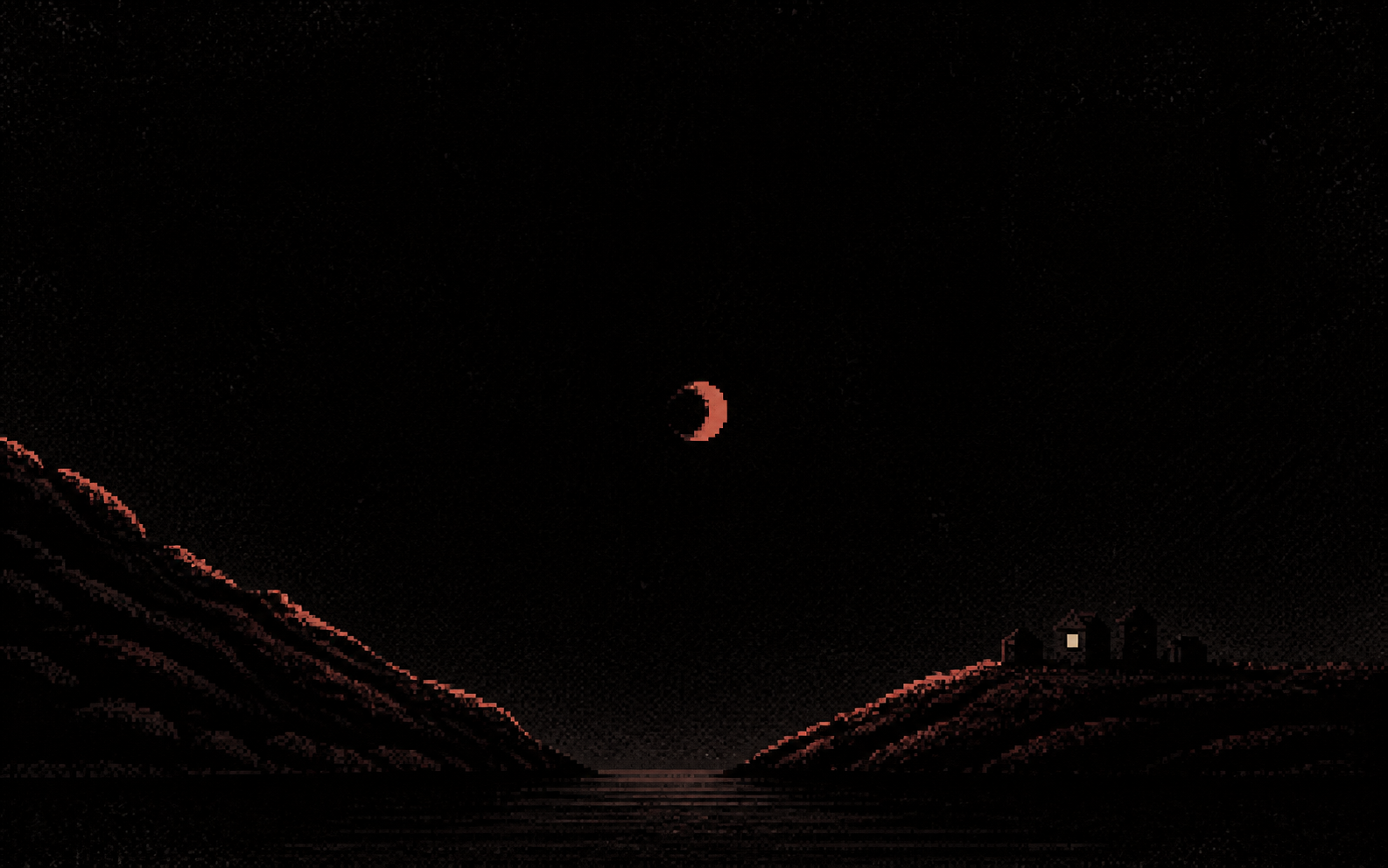
Two dark shores facing each other across a black inland sea, beneath a coral comma-shaped moon and one lit window.

Every time someone runs a first program, morning begins here. It enters from the west with the h and crosses the water one letter at a time.

The place is small: a black inland sea, two roads, and seven houses facing west. Day has never lasted beyond the final period.

At the farthest house lives Mara. She is the only person who remembers the dark between one run and the next.

She leaves one window lit and says hello toward the empty shore. No one has ever answered.

Then her window lit before the program ran. Since that morning, the comma has risen a little closer to her roof.

Now Mara waits for the sentence to close the last small distance.

Maybe hello, world was never the first message.
Maybe it was the first reply.

Hello, world. Hello, Mara.

For the first time, Mara does not say it first.